Introduction
In recent years, generative AI has emerged as a transformative force in various sectors, particularly in finance and banking. By leveraging advanced algorithms, organizations are optimizing operations, enhancing customer experiences, and minimizing risks. This article explores the applications, benefits, and challenges of generative AI in finance and banking, highlighting its impact on the industry.
Understanding Generative AI
Generative AI refers to algorithms capable of creating new content or data based on existing inputs. These systems analyze vast amounts of information and can generate text, images, or other media, often indistinguishable from human-created content. In finance and banking, generative AI can process data at an unprecedented scale, enabling faster and more accurate decision-making.
Applications of Generative AI in Finance and Banking
1. Risk Management
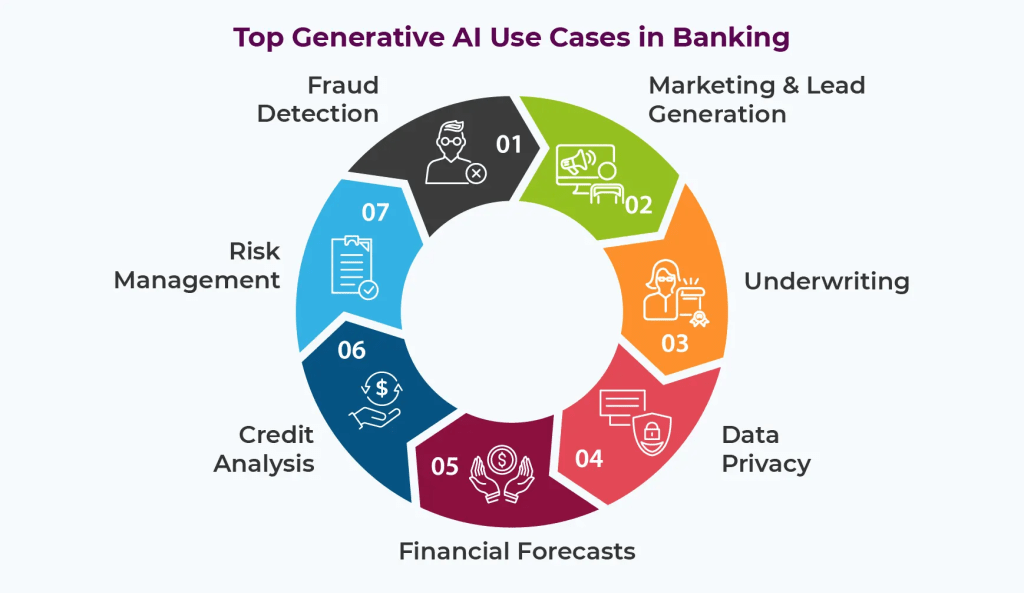
Generative AI plays a crucial role in risk management by predicting potential financial risks and assessing their impact on the organization. By analyzing historical data and identifying patterns, these AI systems can generate models that simulate various scenarios. This predictive capability allows financial institutions to implement proactive measures to mitigate risks, thereby safeguarding their assets and maintaining stability.
2. Fraud Detection
Fraud detection is another significant area where generative AI proves invaluable. Traditional methods often struggle to keep up with the evolving tactics used by fraudsters. Generative AI algorithms can analyze transaction data in real-time, identifying anomalies that may indicate fraudulent activity. By continuously learning from new data, these systems improve their accuracy, enabling financial institutions to respond swiftly to potential threats.
3. Personalized Banking Experience
Generative AI also enhances the customer experience in finance and banking. By analyzing customer data, these algorithms can generate personalized recommendations, product offerings, and financial advice tailored to individual needs. This level of personalization fosters customer loyalty and satisfaction, as clients feel understood and valued by their financial institutions.
4. Automated Report Generation
Another application of generative AI in finance and banking is automated report generation. Financial institutions are required to produce various reports for compliance, risk assessment, and performance analysis. Generative AI can streamline this process by automatically generating comprehensive reports from raw data. This efficiency reduces the time and resources needed for report preparation, allowing staff to focus on more strategic tasks.
5. Investment Strategies
Investment strategies are also evolving with the integration of generative AI. By analyzing market trends and historical performance data, these systems can generate predictive models that assist portfolio managers in making informed investment decisions. This data-driven approach helps financial institutions identify lucrative opportunities and optimize their investment strategies.
Benefits of Generative AI in Finance and Banking
The integration of generative AI in finance and banking brings several benefits:
1. Enhanced Efficiency
Generative AI significantly enhances operational efficiency by automating repetitive tasks and optimizing workflows. This automation reduces the time required for data processing, allowing financial institutions to respond more rapidly to market changes and customer needs.
2. Improved Accuracy
The ability of generative AI to analyze vast datasets leads to improved accuracy in predictions and decision-making. Financial institutions can rely on these insights to make informed choices, minimizing the risk of human error.
3. Cost Savings
By automating various processes and improving efficiency, generative AI can lead to substantial cost savings for financial institutions. Resources can be allocated more effectively, and operational costs can be reduced, ultimately benefiting the bottom line.
4. Enhanced Customer Experience
The personalized services generated by AI contribute to a better overall customer experience. Clients appreciate receiving tailored advice and recommendations, which can foster stronger relationships between customers and their financial institutions.
Challenges and Considerations
Despite its many advantages, the integration of generative AI in finance and banking also presents challenges:
1. Data Privacy and Security
The use of generative AI often involves processing sensitive customer data. Financial institutions must ensure robust data privacy and security measures to protect this information from breaches or misuse.
2. Ethical Concerns
The implementation of AI systems raises ethical concerns, particularly regarding bias in decision-making. Financial institutions must be vigilant in ensuring their algorithms are fair and transparent to avoid discriminatory practices.
3. Regulatory Compliance
As financial institutions increasingly adopt generative AI, they must navigate a complex regulatory landscape. Compliance with laws and regulations is crucial to maintain trust and credibility in the industry.
Conclusion
Generative AI in finance and banking is revolutionizing the industry by enhancing efficiency, improving risk management, and providing personalized customer experiences. As financial institutions continue to explore the potential of this technology, they must address the associated challenges, including data privacy, ethical concerns, and regulatory compliance. By striking a balance between innovation and responsibility, generative AI can shape a more secure and efficient future for the finance and banking sectors.
 Tech Consultancy Blogs
Leave a comment