Generative AI for corporate accounting is revolutionizing how businesses manage their financial processes. This advanced technology offers innovative solutions to enhance efficiency, accuracy, and decision-making in the accounting domain. As organizations increasingly adopt digital transformation strategies, understanding the applications and benefits of generative AI for corporate accounting becomes crucial.
What is Generative AI?
Generative AI refers to algorithms that can generate new content, from text to images, based on the data they are trained on. In the context of corporate accounting, generative AI can analyze vast amounts of financial data to produce insights, automate routine tasks, and even simulate financial scenarios. This technology leverages machine learning, natural language processing, and data analytics to improve the accounting workflow significantly.
Streamlining Data Entry and Management
One of the primary applications of generative AI for corporate accounting is automating data entry and management. Traditionally, accounting teams spend considerable time inputting data into financial systems, which is prone to human error. By utilizing generative AI, organizations can automate data extraction from various sources, such as invoices, receipts, and bank statements. This automation reduces the likelihood of errors and frees up valuable time for accountants to focus on more strategic tasks.
Moreover, generative AI can assist in managing financial records more effectively. With the ability to categorize and organize data intelligently, generative AI enables accounting professionals to maintain accurate and up-to-date financial information effortlessly. This improved data management helps in generating timely reports and financial statements, crucial for informed decision-making.
Enhanced Financial Forecasting
Generative AI for corporate accounting can significantly enhance financial forecasting capabilities. By analyzing historical data and identifying patterns, this technology can generate predictive models that provide insights into future financial performance. Accountants can leverage these models to assess potential risks and opportunities, allowing for more accurate budgeting and resource allocation.
For instance, generative AI can analyze market trends, consumer behavior, and economic indicators to generate forecasts on revenue growth, expenses, and cash flow. By incorporating these insights into their financial strategies, businesses can make more informed decisions, optimizing their financial outcomes.
Improved Compliance and Risk Management
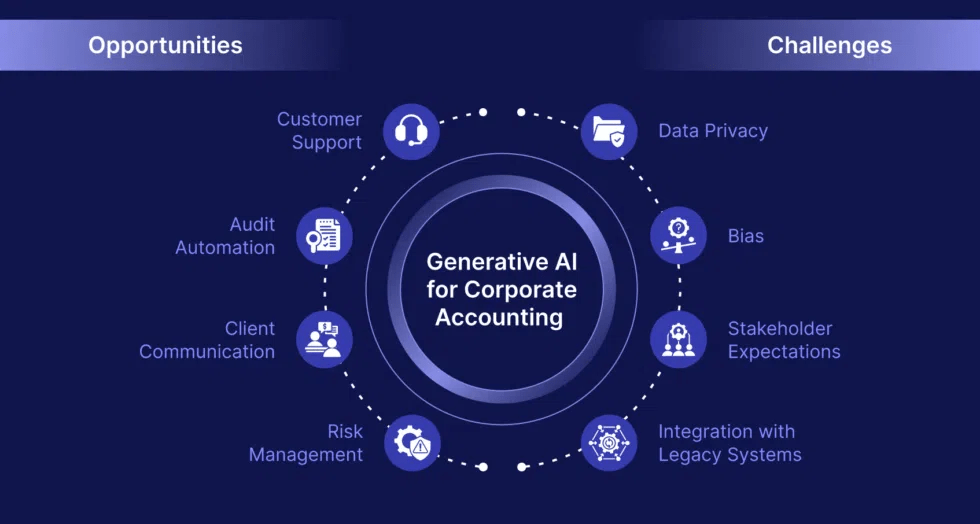
Compliance with regulatory standards is a critical aspect of corporate accounting. Generative AI can streamline the compliance process by automating the monitoring and reporting of financial activities. This technology can analyze transactions in real time, flagging any discrepancies or anomalies that may indicate fraudulent activity or compliance violations. By ensuring adherence to regulations, generative AI helps organizations mitigate risks and avoid costly penalties.
In addition to compliance, generative AI for corporate accounting enhances risk management. By providing real-time insights into financial health and identifying potential risks, accountants can proactively address issues before they escalate. This capability allows organizations to maintain stability and make informed decisions in a rapidly changing business environment.
Optimizing Audit Processes
Auditing is a vital function in corporate accounting that ensures financial statements are accurate and compliant. Generative AI can optimize audit processes by automating data analysis and identifying anomalies. Traditional audits often involve manual reviews of extensive financial records, which can be time-consuming and prone to human error. However, with generative AI, auditors can quickly analyze vast datasets, identifying discrepancies that may warrant further investigation.
Furthermore, generative AI can assist in creating detailed audit reports, providing insights and recommendations for improvement. By streamlining the audit process, organizations can reduce the time and resources required for audits while ensuring a thorough and accurate review of their financial activities.
Supporting Strategic Decision-Making
The insights generated by generative AI for corporate accounting can significantly support strategic decision-making. By providing real-time data analysis and predictive modeling, accountants can gain valuable insights into their organization’s financial health. This information empowers decision-makers to develop informed strategies that align with their business goals.
For instance, generative AI can help organizations assess the financial impact of various scenarios, such as entering new markets or launching new products. By simulating these scenarios and analyzing potential outcomes, businesses can make data-driven decisions that minimize risks and maximize opportunities.
The Future of Generative AI in Corporate Accounting
As technology continues to evolve, the role of generative AI in corporate accounting is expected to grow. Organizations that embrace this innovative technology will likely gain a competitive edge in the market. The potential applications of generative AI are vast, ranging from automated financial reporting to enhanced fraud detection and prevention.
However, for organizations to fully harness the benefits of generative AI, they must invest in training their accounting teams and integrating these technologies into their existing systems. Building a culture of innovation and adaptability will be essential as businesses navigate the changing landscape of corporate accounting.
Conclusion
Generative AI for corporate accounting is a game-changer, offering significant benefits in efficiency, accuracy, and decision-making. By automating routine tasks, enhancing forecasting capabilities, ensuring compliance, optimizing audit processes, and supporting strategic decision-making, generative AI is transforming the accounting landscape. As organizations continue to explore and adopt this technology, the future of corporate accounting looks promising, paving the way for more efficient and effective financial management. Embracing generative AI is not just an option; it is becoming a necessity for businesses aiming to thrive in a competitive environment.
 Tech Consultancy Blogs
Leave a comment