The rapid advancement of artificial intelligence (AI) has brought about significant changes in industries worldwide. One of the most exciting developments in recent years is AutoML (Automated Machine Learning), which is drastically simplifying and accelerating the use of AI. By automating the complex tasks involved in machine learning (ML), AutoML is opening the door for businesses and individuals to harness the power of AI without requiring in-depth knowledge of data science or programming.
Understanding AutoML: A Game-Changer in AI
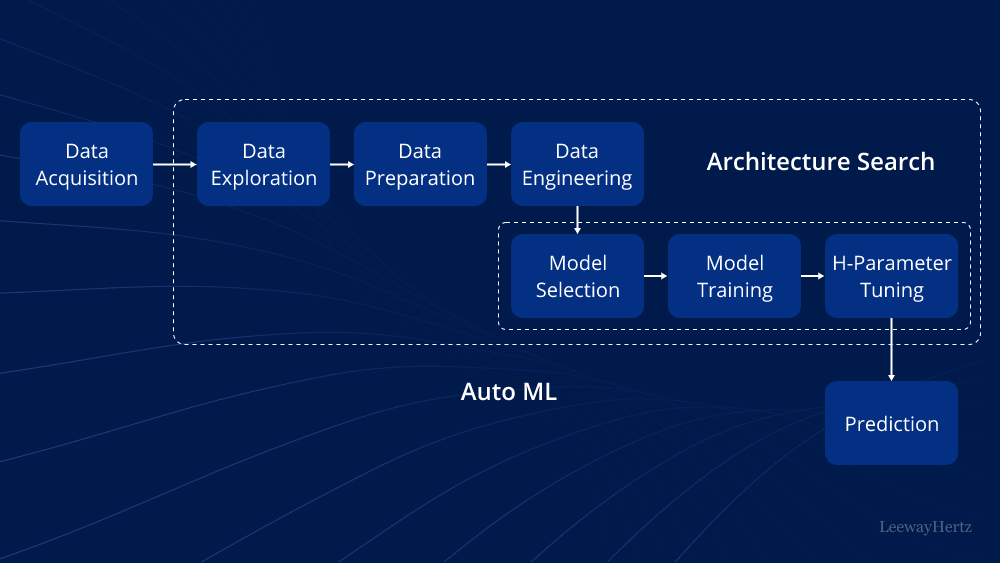
At its core, AutoML refers to the process of automating the end-to-end tasks in the machine learning pipeline. This involves everything from data preprocessing, feature engineering, and model selection to hyperparameter tuning and model evaluation. Traditionally, these tasks would require a team of data scientists and engineers working over extended periods to fine-tune models manually.
AutoML, however, takes the heavy lifting out of these tasks by automating them, thereby reducing the complexity and time it takes to develop and deploy machine learning models. This automation not only enhances efficiency but also makes AI accessible to a much wider range of users, including those without extensive technical expertise.
Democratizing AI with AutoML
One of the most significant ways AutoML is transforming AI is by democratizing its usage. In the past, implementing AI solutions required specialized knowledge in mathematics, statistics, and programming. The introduction of AutoML has made it possible for non-experts to leverage AI tools and create models with little to no coding experience.
This democratization means that small businesses, educators, and professionals from various sectors can now adopt AI to solve problems or improve efficiency. AutoML tools often come with user-friendly interfaces that allow users to input data, define the problem, and let the system take care of the rest. This shift is critical for industries such as healthcare, finance, and retail, where AI-driven insights can lead to better decision-making and improved outcomes.
Speeding Up AI Development
Another significant advantage of AutoML is the acceleration of AI development. AI and machine learning projects traditionally require extensive time and resources to build accurate models. Data scientists must sift through vast amounts of data, experiment with various algorithms, and continuously optimize models, which can take weeks or months.
By automating these processes, AutoML reduces development time dramatically. It can explore multiple algorithms, automatically fine-tune parameters, and select the best-performing model, all within a fraction of the time it would take for a manual process. This increased speed of development means organizations can deploy AI solutions faster, stay ahead of competition, and continuously innovate without being bogged down by lengthy development cycles.
Enhancing Model Accuracy
When it comes to machine learning, accuracy is key. AutoML systems are designed to optimize model performance by automatically testing and selecting the most appropriate algorithms for the problem at hand. Since these systems can explore multiple possibilities in parallel, they are often able to uncover solutions that a human data scientist might miss.
Moreover, AutoML continuously learns from its experiences and improves over time. This means that the more it is used, the more accurate and effective it becomes at solving various problems. For industries like healthcare, where even a small increase in predictive accuracy can have life-saving consequences, the impact of AutoML is immense.
Enabling Cost Efficiency
The automation of machine learning tasks not only saves time but also significantly reduces costs. Hiring a team of experienced data scientists is a costly investment, particularly for small- to medium-sized businesses. AutoML allows organizations to bypass the need for a full-fledged data science team, enabling them to build and deploy models at a fraction of the cost.
Furthermore, AutoML systems often require less computational power compared to traditional machine learning processes, further reducing operational expenses. With AutoML, businesses can achieve high-level AI outcomes without the substantial overhead typically associated with AI development.
Expanding the Reach of AI Across Industries
As AutoML continues to evolve, its applications are expanding across a wide range of industries. From healthcare and finance to agriculture and manufacturing, AI-driven automation is making its mark. In healthcare, AutoML can assist in medical image analysis, diagnosis, and predictive healthcare management, helping professionals provide better patient care.
In the financial sector, AutoML is driving the development of predictive models for risk management, fraud detection, and automated trading. Similarly, in agriculture, farmers can utilize AI models to predict crop yields and optimize resource allocation, ensuring more sustainable farming practices. The retail industry is also benefiting from AutoML through enhanced recommendation systems, demand forecasting, and customer behavior analysis.
As these industries continue to adopt AI technologies powered by AutoML, the overall impact on productivity and innovation is profound.
Reducing Bias and Increasing Fairness in AI
One of the challenges facing AI and machine learning is the risk of bias in algorithms, which can lead to unfair or inaccurate outcomes. AutoML systems are increasingly being designed to address this issue by integrating fairness optimization techniques into the model-building process.
By automating the detection and reduction of bias during the development of AI models, AutoML can help ensure more equitable and fair results. This is especially important in fields like hiring, lending, and healthcare, where biased algorithms could have serious consequences for individuals and society as a whole.
The Future of AI with AutoML
As AI becomes more embedded in the fabric of modern technology, AutoML is set to play a central role in shaping its future. By automating the most complex aspects of machine learning, AutoML is transforming AI from an elite, niche field into a tool that can be widely used across industries and by individuals with varying levels of technical expertise.
In the coming years, we can expect AutoML to become even more sophisticated, driving innovations in AI capabilities and allowing for more intelligent, adaptable systems. It will continue to lower the barriers to AI adoption, empowering businesses of all sizes to leverage AI’s transformative power without the need for extensive technical infrastructure.
Conclusion
AutoML is revolutionizing the world of AI, making it more accessible, cost-efficient, and accurate than ever before. By automating the machine learning process, AutoML is transforming AI into a tool that can be used by anyone, regardless of technical expertise. Its impact on industries such as healthcare, finance, and retail is already evident, and as the technology continues to evolve, its transformative potential will only grow.
 Tech Consultancy Blogs
Leave a comment