Introduction
Agentic Retrieval-Augmented Generation (RAG) represents a significant leap in the realm of artificial intelligence, particularly in how AI models interact with vast amounts of data. By blending the strengths of retrieval mechanisms with generative capabilities, Agentic RAG enables more intelligent, context-aware responses in various applications. This article delves into what Agentic RAG is, explores its different types, examines its wide-ranging applications, and provides insights into its implementation.
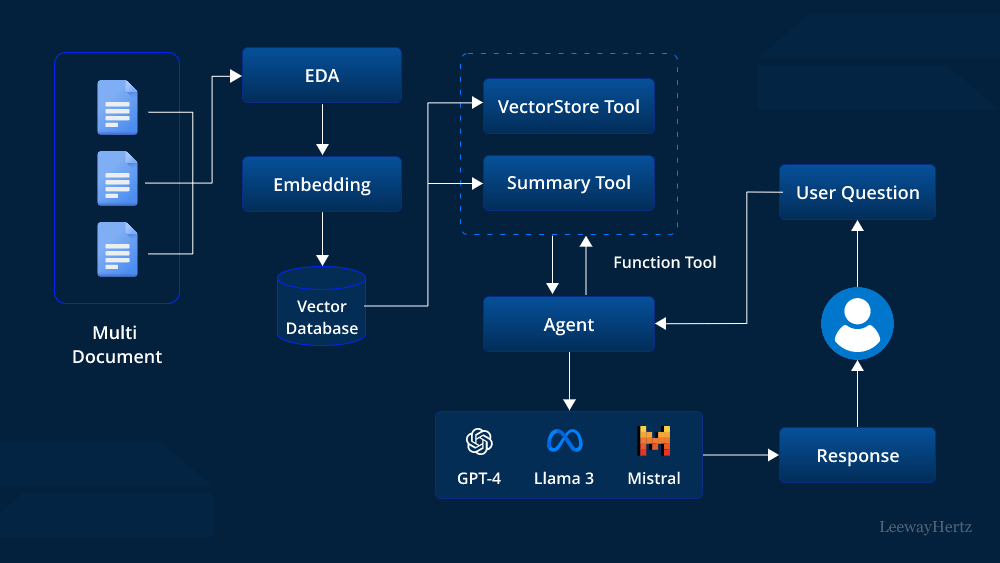
What is Agentic RAG?
Agentic RAG, short for Retrieval-Augmented Generation, is an advanced AI technique that combines the power of information retrieval with the creativity of generative models. In traditional AI models, the system either generates responses based on its internal data or retrieves relevant information from a database. However, Agentic RAG integrates both processes, allowing AI systems to retrieve relevant data from a large corpus and use that data to generate more accurate and contextually appropriate outputs.
This hybrid approach significantly enhances the quality of AI responses, making them more informed and aligned with the user’s needs. The term “Agentic” highlights the model’s ability to act with purpose and autonomy, optimizing the balance between retrieval and generation.
Types of Agentic RAG
Agentic RAG can be categorized into several types based on how retrieval and generation processes are integrated. Understanding these types is crucial for selecting the appropriate model for specific applications.
- Static Agentic RAG:
Static Agentic RAG refers to models where the retrieval component operates on a fixed, pre-determined dataset. The AI system uses this static data source to enhance its generative output. This type is ideal for applications where the data remains relatively constant, such as in specific domain knowledge or well-defined industries. - Dynamic Agentic RAG:
In contrast, Dynamic Agentic RAG leverages continuously updated data sources. The retrieval mechanism dynamically accesses new and relevant information, allowing the AI to generate responses that reflect the latest data. This type is particularly useful in scenarios where information changes rapidly, such as news aggregation or market analysis. - Interactive Agentic RAG:
This type involves a more complex interaction between the user and the AI system. The retrieval and generation processes are closely tied to user input, allowing the AI to refine its responses in real-time based on ongoing interactions. Interactive Agentic RAG is well-suited for customer service bots, personalized recommendations, and interactive learning platforms.
Applications of Agentic RAG
Agentic RAG has a broad range of applications across various industries. Its ability to deliver more accurate, context-aware outputs makes it a valuable tool in many fields.
- Customer Support:
In customer support, Agentic RAG can significantly enhance the efficiency and effectiveness of AI-powered chatbots. By retrieving relevant information from a database of customer queries and support articles, the system can generate personalized and accurate responses, improving customer satisfaction. - Content Creation:
For content creators, Agentic RAG can be a game-changer. It enables AI tools to generate content that is not only creative but also well-informed. Whether it’s writing articles, creating social media posts, or generating marketing copy, the AI can pull in relevant data and create content that resonates with the target audience. - Healthcare:
In healthcare, Agentic RAG can assist in providing accurate medical information to both healthcare providers and patients. By retrieving the latest research and clinical guidelines, the AI can generate informed responses that aid in diagnosis, treatment planning, and patient education. - Education and Training:
Agentic RAG can also play a pivotal role in education and training. AI-driven tutoring systems can retrieve relevant learning materials and generate customized study plans or explanations, adapting to the learner’s needs and pace. - Research and Development:
In research environments, Agentic RAG can streamline the process of literature review and hypothesis generation. Researchers can use the system to pull relevant studies, data, and theories, helping them generate new ideas and insights more efficiently.
Implementing Agentic RAG
Implementing Agentic RAG requires careful planning and a clear understanding of the specific needs of the application. Here are some key steps to successfully implement this technology:
- Identify the Data Sources:
The first step is to identify the data sources that will be used for retrieval. Whether static or dynamic, these sources must be comprehensive, reliable, and relevant to the application. - Choose the Right Model Architecture:
Depending on the application, you may choose a static, dynamic, or interactive Agentic RAG model. The architecture should align with the data sources and the specific needs of the application. - Integrate Retrieval and Generation:
The core of Agentic RAG is the seamless integration of retrieval and generation. This requires sophisticated algorithms that can balance the two processes, ensuring that the retrieval component provides useful information and the generative component creates coherent and contextually appropriate outputs. - Train and Fine-Tune the Model:
Once the model architecture is in place, the next step is training. This involves feeding the model with data and refining its parameters to optimize performance. Fine-tuning is crucial for ensuring that the AI system generates high-quality outputs. - Deploy and Monitor:
After training, the model is deployed in the real-world application. Continuous monitoring is essential to ensure that the system performs as expected and adapts to any changes in the data or user requirements.
Conclusion
Agentic RAG represents a powerful advancement in AI technology, offering a hybrid approach that enhances both the accuracy and creativity of AI-generated outputs. By understanding the different types of Agentic RAG, exploring its various applications, and following best practices for implementation, businesses and developers can harness this technology to create more intelligent and responsive AI systems. Whether in customer support, content creation, healthcare, or education, Agentic RAG is poised to play a transformative role in the future of AI.
 Tech Consultancy Blogs
Leave a comment