Large Language Models (LLMs) have revolutionized how we interact with artificial intelligence, from chatbots to advanced data analysis. However, as powerful as these models are, one of the most significant advancements is the ability to produce structured outputs in LLMs. Structured outputs not only improve the precision of information retrieval but also enable these models to be utilized across a wider range of applications.
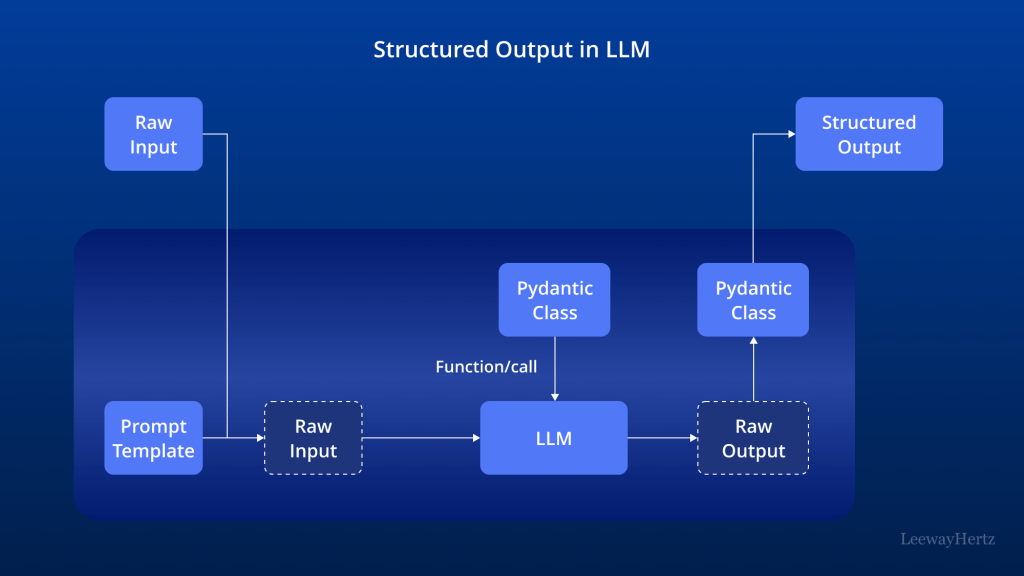
What are Structured Outputs in LLMs?
Structured outputs in LLMs refer to the organized and formatted responses generated by these models. Instead of producing unstructured, free-flowing text, structured outputs present information in a defined format, such as tables, lists, or JSON objects. This structured approach helps to categorize and present information clearly and concisely, making it easier for users to understand and use the generated data.
For instance, when querying an LLM for data on a specific topic, structured outputs can present the information in a tabular format, highlighting key points and statistics. This contrasts with traditional text generation, where information might be buried within lengthy paragraphs.
Why are Structured Outputs Important in LLMs?
The importance of structured outputs in LLMs lies in their ability to enhance the usability and clarity of generated data. Here are some key benefits:
- Improved Readability and Accessibility: Structured outputs make complex data easier to digest. For example, converting dense information into bullet points or a table allows users to quickly scan and extract relevant details without wading through irrelevant text.
- Enhanced Accuracy and Consistency: When LLMs generate structured outputs, they adhere to predefined formats that reduce ambiguity. This consistency is crucial in applications such as financial analysis, medical reporting, or any field where precise data representation is vital.
- Better Integration with Other Systems: Structured outputs are easier to integrate into other software and platforms. For instance, JSON-formatted responses can be directly used in web applications or databases, streamlining data processing and analysis workflows.
Applications of Structured Outputs in LLMs
Structured outputs in LLMs have a wide range of applications across various industries. Here are some notable examples:
1. Data Analysis and Reporting
In data analysis, structured outputs enable LLMs to generate clear, concise reports that can be easily interpreted by stakeholders. For instance, an LLM can summarize sales data in a table, showing revenue, growth rates, and key performance indicators, allowing for quick decision-making.
2. Customer Support Automation
Customer support systems often use LLMs to handle queries and provide assistance. By using structured outputs, these systems can deliver information in a clear and organized manner, such as listing steps to resolve an issue or providing a structured FAQ format. This approach improves customer satisfaction by reducing confusion and making instructions easier to follow.
3. Content Creation and Curation
LLMs can assist in content creation by generating structured outlines, bullet points, or summaries. This is particularly useful in fields like journalism, where information needs to be presented clearly and concisely. Structured outputs help writers quickly gather key facts and present them in a digestible format.
4. Financial and Legal Analysis
In finance and legal sectors, where precision is paramount, LLMs with structured outputs can present contract summaries, financial forecasts, or risk assessments in a standardized format. This ensures that critical information is not lost in translation and can be readily acted upon.
Challenges in Implementing Structured Outputs in LLMs
While the advantages are clear, implementing structured outputs in LLMs also presents challenges:
- Complexity in Design: Creating the rules and formats for structured outputs requires careful planning and a deep understanding of the intended application. Developers must ensure that the LLM can accurately recognize and produce the required structure.
- Handling Ambiguity: LLMs may struggle with ambiguous or poorly defined input queries, leading to incorrect or incomplete structured outputs. Continuous refinement and training are required to minimize these errors.
- Balancing Flexibility and Structure: LLMs must maintain a balance between generating flexible, creative responses and adhering to strict structured output formats. Finding this balance can be challenging, especially in more complex or nuanced tasks.
The Future of Structured Outputs in LLMs
As LLMs continue to evolve, the role of structured outputs will become increasingly significant. Advances in AI and machine learning are expected to improve the ability of LLMs to generate highly accurate and contextually relevant structured outputs, further enhancing their usability across industries.
Future developments may include more sophisticated models capable of understanding and generating multi-layered structures, such as nested tables or complex data visualizations. Additionally, improved natural language processing capabilities will likely reduce the errors and ambiguities currently associated with structured output generation.
Conclusion
Structured outputs in LLMs are transforming how we leverage artificial intelligence, offering improved clarity, accuracy, and integration capabilities. As these models continue to develop, their ability to produce structured outputs will undoubtedly open new doors for innovation and efficiency across numerous fields. Understanding and harnessing this capability will be key for businesses and developers looking to maximize the potential of LLMs in their operations.
 Tech Consultancy Blogs
Leave a comment