Multi-agent systems (MAS) represent a fascinating and powerful approach to solving complex problems through decentralized decision-making. This article explores the fundamental concepts of multi-agent systems, including their types, operational mechanisms, applications, and benefits.
What is a Multi-Agent System?
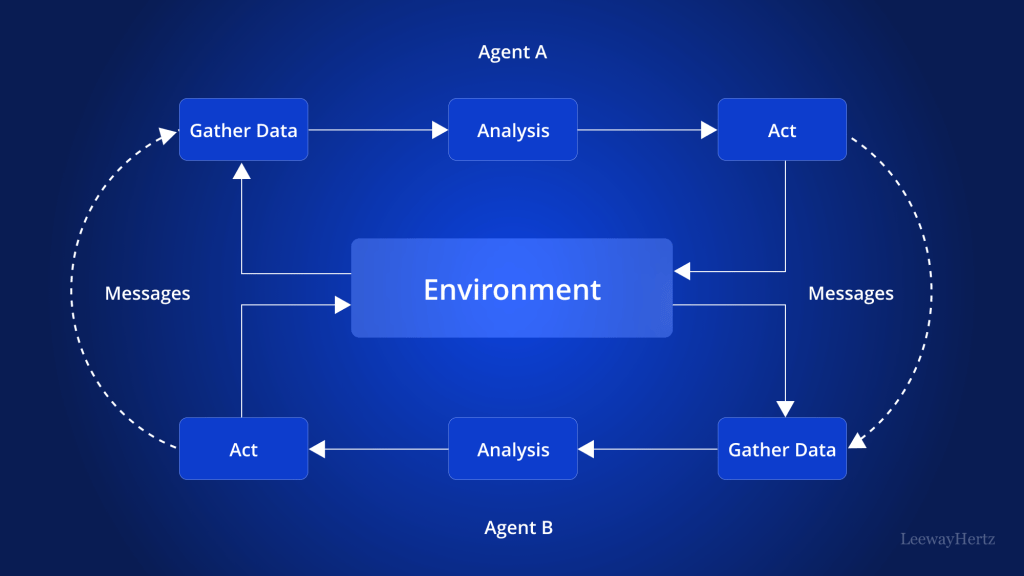
A multi-agent system (MAS) is a system composed of multiple interacting agents, each with its own set of capabilities and objectives. These agents can be software-based, robotic, or even human. The key feature of MAS is the autonomous nature of its agents, which allows them to make decisions and interact with each other and their environment to achieve specific goals.
Types of Multi-Agent Systems
- Homogeneous Multi-Agent Systems:
In homogeneous MAS, all agents are identical in terms of their capabilities and functions. They operate under the same set of rules and principles, which simplifies coordination and cooperation. An example of a homogeneous MAS could be a swarm of robots working together to complete a search-and-rescue mission. - Heterogeneous Multi-Agent Systems:
Unlike homogeneous systems, heterogeneous MAS consists of agents with varying capabilities and roles. This diversity allows for more complex interactions and can be more adaptable to different scenarios. For instance, in a smart city infrastructure, you might have agents managing traffic lights, monitoring environmental conditions, and providing emergency responses. - Reactive Multi-Agent Systems:
Reactive MAS agents respond to changes in their environment based on predefined rules or conditions. They do not have a long-term plan but react to immediate stimuli. This type of MAS is often used in real-time systems where quick responses are critical. - Proactive Multi-Agent Systems:
Proactive agents in a MAS have the ability to plan and make decisions based on future goals. These agents anticipate potential future scenarios and act in a way that moves them closer to achieving their objectives. For example, a proactive MAS might be used in financial trading, where agents make investment decisions based on market predictions.
How Do Multi-Agent Systems Work?
Multi-agent systems operate through a combination of coordination, communication, and cooperation among agents. Here’s a simplified breakdown of their working mechanism:
- Coordination:
Agents in a MAS coordinate their actions to achieve common goals. Coordination involves managing interactions and ensuring that agents do not work at cross purposes. Techniques like negotiation and consensus building are often employed to align the agents’ actions. - Communication:
Effective communication is crucial for the success of a MAS. Agents exchange information about their state, goals, and intentions through various communication protocols. This information sharing helps agents make informed decisions and collaborate effectively. - Cooperation:
Cooperation among agents involves working together to achieve shared objectives. Agents may need to share resources, synchronize their actions, or support each other in complex tasks. Cooperation can enhance the overall efficiency and effectiveness of the system.
Applications of Multi-Agent Systems
Multi-agent systems have a wide range of applications across various domains. Here are some notable examples:
- Robotics:
MAS are commonly used in robotics, particularly in swarm robotics, where multiple robots work together to perform tasks such as exploration, surveillance, and rescue missions. The distributed nature of MAS allows robots to handle complex environments more effectively. - Transportation:
In intelligent transportation systems, MAS can manage traffic flow, optimize routes, and improve safety. For instance, MAS can coordinate traffic signals and control autonomous vehicles to reduce congestion and enhance efficiency. - Healthcare:
In healthcare, MAS can be used to manage patient care, coordinate medical teams, and optimize resource allocation. For example, MAS can help in scheduling surgeries, managing hospital inventories, and facilitating telemedicine services. - Finance:
Financial markets benefit from MAS through automated trading systems, fraud detection, and portfolio management. Agents in financial MAS can analyze market trends, execute trades, and make investment decisions with minimal human intervention. - Smart Homes and Cities:
MAS play a crucial role in smart homes and cities by managing energy consumption, security systems, and public services. Agents can optimize energy use, monitor environmental conditions, and provide real-time information to residents.
Benefits of Multi-Agent Systems
- Scalability:
MAS can scale efficiently as the number of agents can be increased or decreased based on the requirements of the task. This flexibility allows MAS to handle both small and large-scale problems effectively. - Robustness:
The decentralized nature of MAS makes them more robust to failures. If one agent fails, others can continue to operate, ensuring that the system remains functional and resilient. - Flexibility:
MAS can adapt to changes in the environment or objectives. Agents can modify their behavior based on new information, making MAS suitable for dynamic and unpredictable scenarios. - Enhanced Problem Solving:
By leveraging the collective intelligence of multiple agents, MAS can solve complex problems more efficiently than single-agent systems. This collective approach often leads to more innovative and effective solutions. - Autonomy:
MAS agents operate autonomously, reducing the need for centralized control and allowing for more efficient and timely decision-making. This autonomy can lead to faster responses and reduced operational overhead.
Conclusion
Multi-agent systems represent a powerful paradigm for solving complex problems through decentralized decision-making and collaboration. By understanding the different types of MAS, their working principles, and their diverse applications, we can appreciate their potential benefits in various fields. As technology continues to evolve, multi-agent systems are likely to play an increasingly important role in shaping the future of automation and intelligent systems.
 Tech Consultancy Blogs
Leave a comment