In the evolving landscape of AI-driven information retrieval, Advanced Retrieval-Augmented Generation (Advanced RAG) stands out as a powerful tool that integrates retrieval mechanisms with generative models. Advanced RAG goes beyond traditional methods by enhancing the ability of AI systems to fetch relevant information from vast data sources and generate meaningful, context-rich responses. This article explores the architecture, techniques, applications, and use cases of Advanced RAG, highlighting its significance in modern AI development.
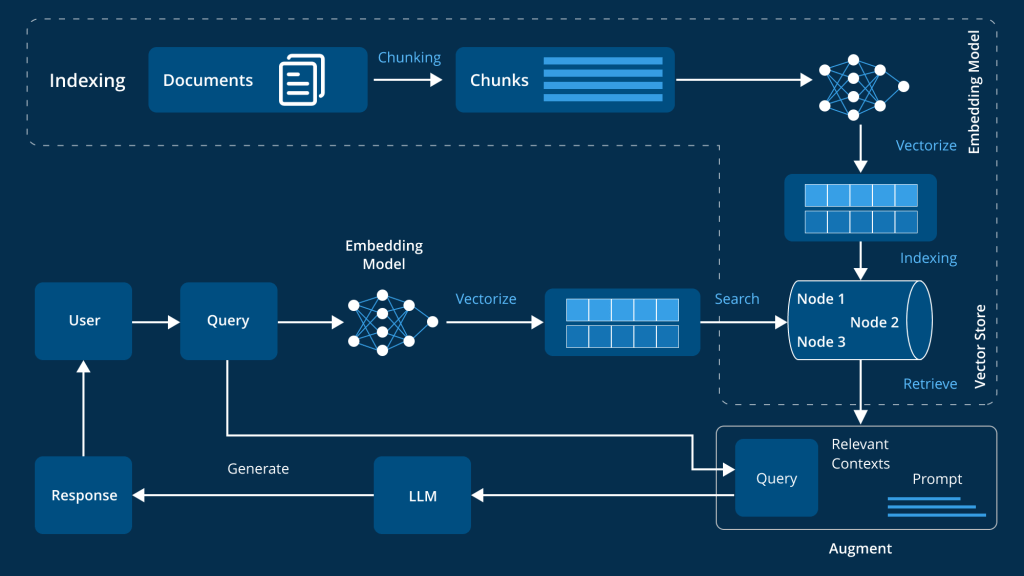
Understanding the Architecture of Advanced RAG
1. Overview of Advanced RAG Architecture
Advanced RAG combines two key components: a retrieval model and a generative model. The retrieval model searches large datasets, extracting relevant information based on a given query, while the generative model synthesizes the extracted data into coherent responses.
The architecture of Advanced RAG is designed to work in tandem:
- Retriever: This component fetches the most relevant pieces of information from a predefined knowledge base, database, or other sources. It uses vector embeddings and similarity searches to quickly locate the best matching documents.
- Generator: The generative model, often based on large language models like GPT, utilizes the retrieved data to generate human-like responses. It blends the retrieved content with learned knowledge, ensuring responses are accurate, informative, and contextually appropriate.
- End-to-End Integration: The interaction between the retriever and generator is tightly integrated, allowing for feedback loops that refine the retrieval and generation processes. This iterative approach improves response quality, relevance, and overall performance.
Key Techniques in Advanced RAG
1. Hybrid Retrieval Techniques
Advanced RAG utilizes a combination of dense and sparse retrieval techniques:
- Dense Retrieval: This technique employs neural networks to create vector representations of documents and queries, making it possible to match them in high-dimensional space. Dense retrieval excels in capturing semantic meanings, enhancing the relevance of the results.
- Sparse Retrieval: This approach relies on traditional keyword matching algorithms, such as TF-IDF or BM25, which are useful for identifying exact terms within documents. Combining sparse retrieval with dense techniques ensures that Advanced RAG captures both exact matches and nuanced, semantically related information.
2. Reinforcement Learning and Feedback Loops
Reinforcement learning plays a critical role in optimizing the retrieval and generation process. Advanced RAG systems can be fine-tuned with human feedback or predefined metrics, continuously improving their performance. Feedback loops enable the system to learn from errors, refine retrieval strategies, and produce more accurate outputs over time.
3. Contextual Embedding and Memory Augmentation
Advanced RAG often incorporates memory components that allow the system to maintain context across multiple interactions. By embedding historical interactions and using context-aware retrieval, Advanced RAG systems can provide more personalized and contextually relevant responses.
Applications and Use Cases of Advanced RAG
1. Enhanced Customer Support
Advanced RAG is revolutionizing customer support by enabling chatbots and virtual assistants to provide more precise and relevant answers. By retrieving information from comprehensive databases and generating customized responses, these AI systems can address complex customer queries, enhancing the overall user experience.
2. Knowledge Management Systems
Organizations use Advanced RAG to power knowledge management systems, ensuring employees have access to the most relevant information when needed. This is particularly useful in industries such as healthcare, finance, and legal services, where quick access to accurate information is crucial.
3. Content Generation and Summarization
Content creation platforms leverage Advanced RAG to generate summaries, articles, or reports from large datasets. By pulling in relevant data and crafting coherent narratives, Advanced RAG helps content creators save time and ensure their output is accurate and data-driven.
4. Personalized Education and Learning Platforms
Advanced RAG is used in educational technology to provide personalized learning experiences. By retrieving relevant learning materials and generating explanations tailored to individual learning styles, Advanced RAG can support more effective and engaging education.
5. Research Assistance and Document Retrieval
Advanced RAG assists researchers by retrieving pertinent academic papers, reports, or articles based on complex queries. It streamlines the research process, allowing scholars to access the most relevant literature without manual searching.
Development and Future Directions of Advanced RAG
The development of Advanced RAG continues to evolve, driven by advancements in AI, natural language processing, and machine learning. Key areas of focus include improving retrieval accuracy, reducing response latency, and enhancing the generative capabilities of models.
1. Multi-Modal Integration
Future Advanced RAG systems are expected to integrate multi-modal data sources, such as text, images, and videos. This will enable the generation of richer, more context-aware responses that span different types of content, making AI more versatile in its applications.
2. Scalability and Efficiency
Developers are working on scaling Advanced RAG systems to handle larger datasets more efficiently. Techniques such as distributed retrieval and optimized indexing are being employed to ensure that Advanced RAG can serve enterprise-level demands without compromising on speed or accuracy.
3. Ethical Considerations and Bias Mitigation
As Advanced RAG continues to develop, ethical considerations are paramount. Efforts are being made to reduce biases in retrieval and generation, ensuring that the system’s outputs are fair, unbiased, and reflective of diverse perspectives.
Conclusion
Advanced RAG represents a significant leap in AI capabilities, combining powerful retrieval mechanisms with advanced generative models to deliver accurate, context-rich responses. Its applications span industries, enhancing customer support, content generation, education, and research. As development continues, Advanced RAG is poised to redefine how we interact with information, making it a cornerstone technology in the AI landscape.
 Tech Consultancy Blogs
Leave a comment