Introduction
Generative AI is transforming many industries, and finance and banking are no exceptions. This technology, which uses artificial intelligence to generate new data and insights, is revolutionizing how financial institutions operate. This article explores the current state of generative AI in finance and banking, its applications, and its future implications.
What is Generative AI?
Generative AI refers to algorithms that create new data from existing data. Unlike traditional AI, which often focuses on analyzing and interpreting data, generative AI can produce new information, such as text, images, and even financial predictions. In finance and banking, generative AI is being used to enhance decision-making, improve customer experiences, and streamline operations.
Current Applications of Generative AI in Finance and Banking
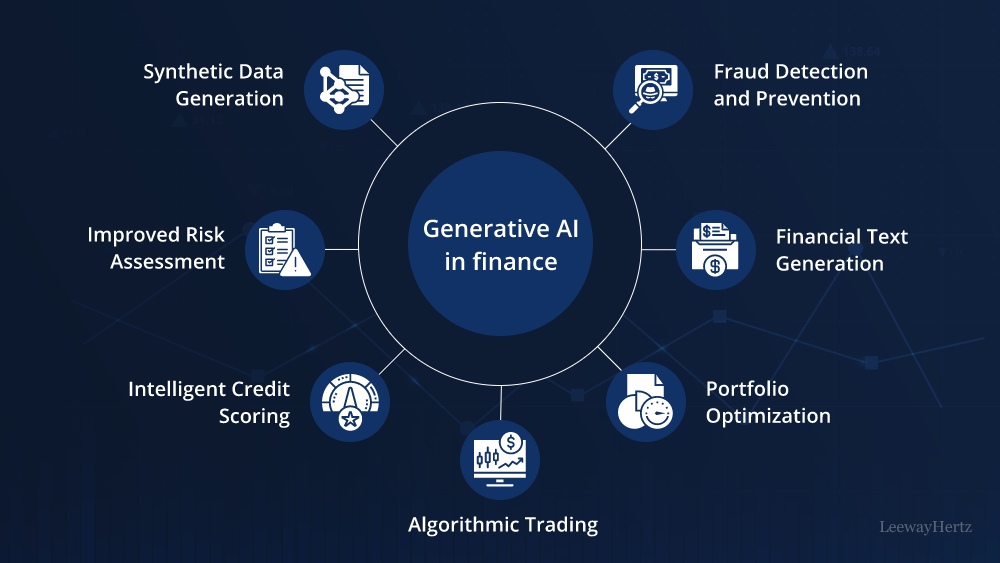
- Fraud Detection and Prevention
Generative AI in finance and banking is increasingly used for detecting and preventing fraud. By analyzing patterns in transaction data, AI models can identify anomalies that might indicate fraudulent activity. For example, if a customer’s spending pattern suddenly changes, generative AI can flag this as suspicious and trigger further investigation. This helps banks mitigate risks and protect their customers.
- Risk Management
Generative AI enhances risk management by simulating various financial scenarios. These simulations help banks understand potential risks and prepare strategies to mitigate them. For instance, generative AI can model economic downturns or sudden market changes, providing insights into how these events could impact financial portfolios. This allows banks to develop more robust risk management strategies and improve their resilience to economic shocks.
- Personalized Financial Services
Generative AI in finance and banking also plays a significant role in personalizing financial services. By analyzing customer data, AI can generate personalized financial recommendations, investment strategies, and even tailored marketing campaigns. For example, if a customer frequently saves a certain percentage of their income, generative AI can suggest investment options that align with their saving habits and financial goals.
- Customer Support
Customer support in finance and banking is being revolutionized by generative AI. AI-powered chatbots and virtual assistants can handle a wide range of customer inquiries, from simple account balance checks to complex financial advice. These AI systems can generate responses based on a customer’s history and preferences, providing a more personalized and efficient support experience. As a result, banks can reduce operational costs and improve customer satisfaction.
Future Implications of Generative AI in Finance and Banking
- Enhanced Decision-Making
In the future, generative AI in finance and banking will further enhance decision-making processes. Advanced AI algorithms will be able to generate more accurate financial forecasts and market predictions. This will enable financial institutions to make better investment decisions and optimize their strategies. For example, AI could predict market trends with higher accuracy, allowing banks to adjust their portfolios in real time.
- Increased Automation
Generative AI is expected to drive increased automation in the financial sector. Many routine tasks, such as data entry, transaction processing, and compliance checks, can be automated using AI. This will lead to significant cost savings and operational efficiencies for banks. Moreover, automation will allow financial professionals to focus on more strategic tasks, such as relationship management and business development.
- Improved Financial Inclusion
Generative AI has the potential to improve financial inclusion by making financial services more accessible to underserved populations. AI-powered systems can analyze alternative data sources, such as mobile phone usage or social media activity, to assess creditworthiness and provide financial services to individuals who may not have access to traditional banking. This can help bridge the gap between different socioeconomic groups and promote financial equity.
- Ethical and Regulatory Challenges
As generative AI continues to evolve, it will raise ethical and regulatory challenges. Financial institutions will need to ensure that their AI systems are transparent, unbiased, and secure. Regulations will need to be updated to address issues related to data privacy, algorithmic fairness, and accountability. Addressing these challenges will be crucial for the responsible development and deployment of generative AI in finance and banking.
Conclusion
Generative AI in finance and banking is transforming the industry in profound ways. From enhancing fraud detection and risk management to personalizing customer services and increasing automation, the applications of generative AI are vast and varied. As this technology continues to evolve, it will shape the future of finance and banking, driving innovation and improving efficiencies. However, it will also bring challenges that must be addressed to ensure that AI is used ethically and responsibly. The journey of generative AI in finance and banking is just beginning, and its impact will be felt for years to come.
 Tech Consultancy Blogs
Leave a comment