In today’s data-driven world, organizations are inundated with vast amounts of information. To harness the full potential of this data, many are turning to AI agents for data analysis. These sophisticated tools can help businesses gain insights, make informed decisions, and stay competitive. This article will explore how AI agents for data analysis work, their benefits, and their role in transforming the way we handle and interpret data.
What Are AI Agents for Data Analysis?
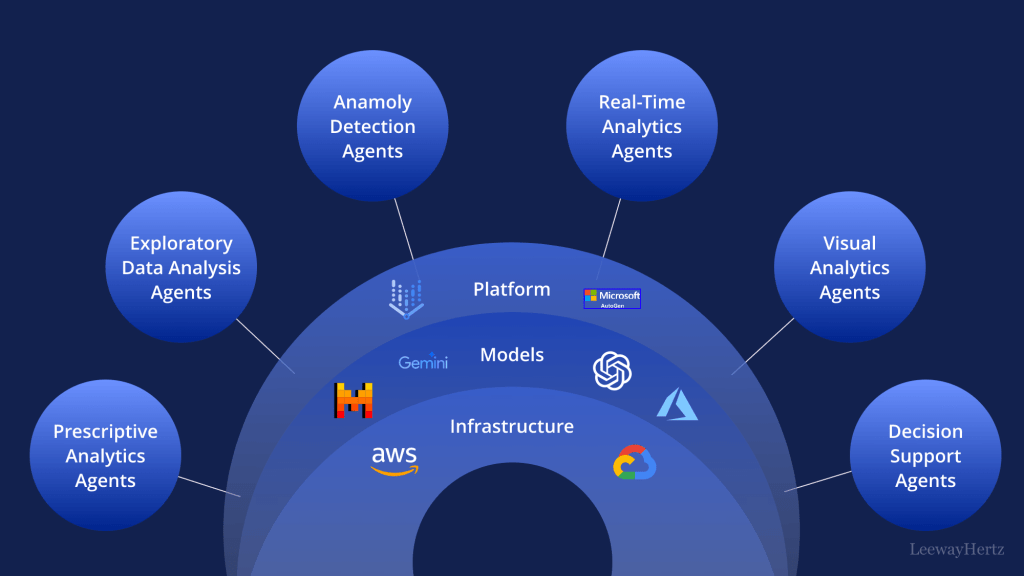
AI agents for data analysis are intelligent software systems designed to process, interpret, and analyze large datasets. Unlike traditional data analysis tools that require manual input and configuration, AI agents use advanced algorithms and machine learning techniques to automate the analysis process. These agents can sift through enormous amounts of data, identify patterns, and provide actionable insights without requiring constant human oversight.
How Do AI Agents for Data Analysis Work?
AI agents for data analysis utilize several key technologies to perform their tasks efficiently:
- Machine Learning (ML): AI agents use ML algorithms to learn from historical data and make predictions about future trends. This involves training the AI on existing datasets so it can recognize patterns and anomalies in new data.
- Natural Language Processing (NLP): NLP enables AI agents to understand and process human language. This is particularly useful for analyzing unstructured data such as customer reviews or social media comments.
- Data Mining: AI agents use data mining techniques to extract useful information from large datasets. This process involves discovering patterns, correlations, and insights that may not be immediately apparent.
- Automation: One of the significant advantages of AI agents for data analysis is their ability to automate repetitive tasks. This frees up human analysts to focus on more complex and strategic tasks.
Benefits of Using AI Agents for Data Analysis
- Enhanced Accuracy: AI agents reduce the risk of human error by performing data analysis tasks with a high degree of precision. This ensures that the insights derived from the data are reliable and accurate.
- Increased Efficiency: By automating data analysis processes, AI agents significantly speed up the time required to generate insights. This allows organizations to respond more quickly to changing market conditions and emerging trends.
- Scalability: AI agents can handle vast amounts of data with ease, making them ideal for large organizations with complex data needs. As data volumes grow, AI agents can scale to accommodate these increases without a loss in performance.
- Cost Savings: By reducing the need for manual analysis and streamlining data processing, AI agents help organizations save on labor costs and operational expenses.
- Advanced Insights: AI agents can uncover insights that might be missed by traditional analysis methods. Their ability to analyze complex datasets and recognize subtle patterns provides a deeper understanding of the data.
Real-World Applications of AI Agents for Data Analysis
- Healthcare: In healthcare, AI agents are used to analyze patient data, predict disease outbreaks, and personalize treatment plans. They can process medical records, research studies, and patient feedback to provide actionable insights for improving patient care.
- Finance: Financial institutions use AI agents for data analysis to detect fraudulent transactions, assess credit risk, and optimize investment strategies. These agents help in managing financial portfolios and forecasting market trends.
- Retail: Retailers leverage AI agents to analyze customer behavior, optimize inventory levels, and personalize marketing efforts. By understanding purchasing patterns and customer preferences, retailers can enhance the shopping experience and increase sales.
- Manufacturing: AI agents assist in monitoring production processes, predicting equipment failures, and improving supply chain management. They help manufacturers maintain operational efficiency and reduce downtime.
Challenges and Considerations
While AI agents for data analysis offer numerous benefits, there are also challenges to consider:
- Data Privacy: The use of AI agents requires handling sensitive data, raising concerns about data privacy and security. Organizations must ensure that their data practices comply with regulations and protect user information.
- Integration: Integrating AI agents into existing systems can be complex. Organizations need to ensure that these tools work seamlessly with their current data infrastructure.
- Bias and Fairness: AI agents can inadvertently introduce biases if they are trained on biased datasets. It is crucial to implement measures to detect and mitigate any biases to ensure fair and unbiased analysis.
The Future of AI Agents for Data Analysis
The future of AI agents for data analysis looks promising, with continuous advancements in technology. As AI algorithms become more sophisticated and data processing capabilities improve, these agents will play an even more significant role in transforming how we analyze and interpret data. Businesses that adopt AI agents early will likely gain a competitive edge by leveraging insights that drive innovation and strategic decision-making.
Conclusion
AI agents for data analysis are revolutionizing the way organizations handle and interpret data. By automating analysis processes, enhancing accuracy, and providing advanced insights, these agents offer significant benefits across various industries. As technology continues to evolve, AI agents will become increasingly integral to data-driven decision-making, making it essential for businesses to embrace these innovations to stay ahead in a competitive landscape.
 Tech Consultancy Blogs
Leave a comment