Introduction
Generative AI in Finance is rapidly transforming how financial institutions operate, offering innovative solutions that enhance efficiency, accuracy, and customer experience. This article explores the applications, benefits, and future potential of Generative AI in the financial sector.
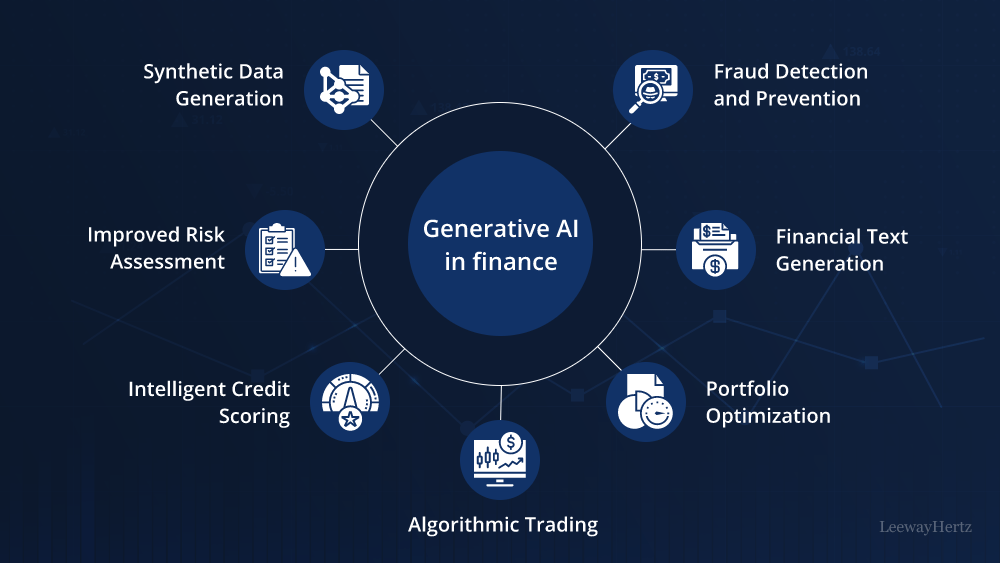
What is Generative AI?
Generative AI refers to algorithms that can generate new content, including text, images, and even entire virtual environments. These models, such as GPT (Generative Pre-trained Transformer), learn patterns and structures from existing data and use this knowledge to create new outputs. In finance, this capability is leveraged to automate processes, predict market trends, and enhance decision-making.
Applications of Generative AI in Finance
1. Automated Financial Reporting
One of the most significant applications of Generative AI in Finance is in automating the creation of financial reports. Traditionally, generating financial statements and reports is a time-consuming process that requires meticulous attention to detail. Generative AI can automate this process by analyzing financial data and generating comprehensive reports, thus saving time and reducing the risk of errors.
2. Fraud Detection and Prevention
Generative AI is also instrumental in enhancing fraud detection and prevention mechanisms. By analyzing large datasets, AI models can identify patterns and anomalies that may indicate fraudulent activity. These systems can generate alerts and reports, enabling financial institutions to respond swiftly and mitigate potential risks.
3. Customer Service and Personalization
In the realm of customer service, Generative AI in Finance has led to the development of sophisticated chatbots and virtual assistants. These AI-driven tools can handle customer inquiries, provide financial advice, and personalize interactions based on the customer’s financial history and preferences. This level of personalization improves customer satisfaction and loyalty.
4. Market Predictions and Investment Strategies
Generative AI models are adept at analyzing vast amounts of market data to predict trends and inform investment strategies. By generating simulations and forecasts, these models help financial analysts and investors make data-driven decisions. This capability is particularly valuable in volatile markets where timely and accurate predictions can significantly impact investment outcomes.
5. Risk Management
Effective risk management is crucial in finance, and Generative AI plays a pivotal role in this area. AI models can simulate various economic scenarios and their potential impacts on financial portfolios. By generating these scenarios, financial institutions can better understand potential risks and devise strategies to mitigate them.
Benefits of Generative AI in Finance
1. Enhanced Efficiency
Generative AI streamlines many financial processes, from report generation to customer service, significantly enhancing operational efficiency. This allows financial professionals to focus on more strategic tasks rather than routine, repetitive work.
2. Improved Accuracy
AI models excel at analyzing data with high precision, reducing the likelihood of errors in financial reporting and analysis. This accuracy is crucial for maintaining the integrity of financial operations and ensuring compliance with regulatory standards.
3. Cost Reduction
By automating tasks that would otherwise require significant human resources, Generative AI helps financial institutions reduce operational costs. This cost efficiency is beneficial for both the institutions and their customers.
4. Better Decision-Making
Generative AI provides financial professionals with deeper insights and more accurate predictions, facilitating better decision-making. This can lead to more effective investment strategies, improved risk management, and ultimately, better financial performance.
5. Enhanced Customer Experience
With the ability to provide personalized services and respond to customer inquiries quickly and accurately, Generative AI significantly enhances the customer experience. Satisfied customers are more likely to remain loyal and engage more deeply with financial services.
Challenges and Considerations
While Generative AI offers numerous benefits, its implementation in finance also presents challenges. Data privacy and security are paramount concerns, as financial institutions handle sensitive information. Ensuring compliance with regulatory standards and maintaining transparency in AI decision-making processes are also critical considerations. Additionally, the integration of AI systems requires significant investment in technology and training.
Future Prospects
The future of Generative AI in Finance looks promising. As AI technology continues to advance, we can expect even more sophisticated applications that further enhance the efficiency and effectiveness of financial operations. Innovations such as AI-driven financial advisors and more advanced predictive models will likely become mainstream, transforming the financial landscape.
Conclusion
Generative AI in Finance is a powerful tool that is revolutionizing the industry. From automating financial reporting to enhancing customer service, AI’s applications are vast and impactful. While challenges remain, the benefits of adopting Generative AI far outweigh the potential drawbacks. As technology evolves, financial institutions that embrace Generative AI will be well-positioned to lead in an increasingly competitive market.
 Tech Consultancy Blogs
Leave a comment