Financial compliance ensures that financial institutions adhere to regulations designed to protect consumers and maintain market integrity. As the regulatory landscape becomes increasingly complex, Artificial Intelligence (AI) emerges as a powerful tool for enhancing compliance efforts. This article explores how AI for financial compliance is transforming the industry, its benefits, and the challenges it faces.
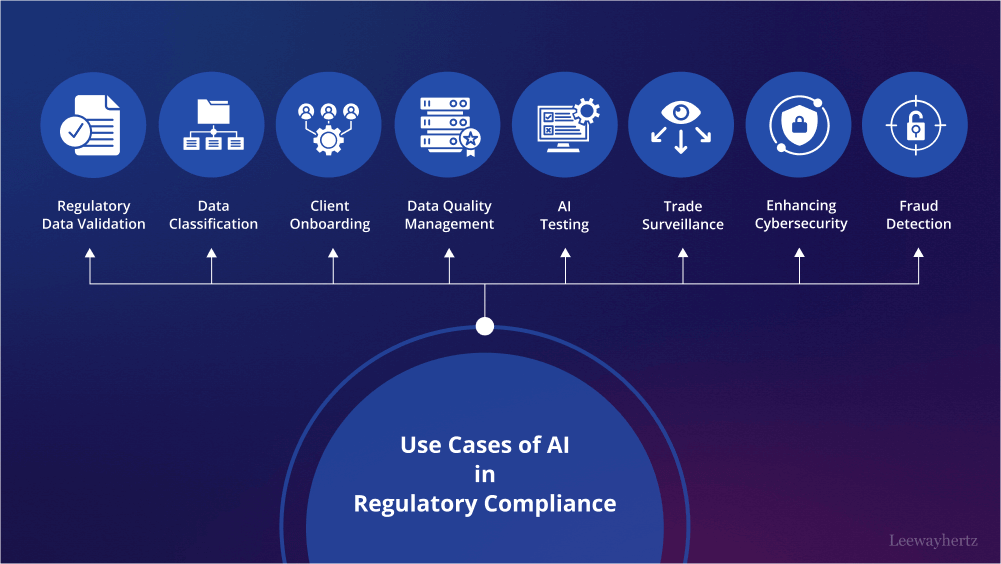
The Rise of AI in Financial Compliance
Understanding Financial Compliance
Financial compliance refers to adherence to laws and regulations set by regulatory bodies to prevent financial crimes such as money laundering, fraud, and insider trading. Compliance ensures financial institutions avoid hefty fines and reputational damage.
The Role of AI in Compliance
AI technologies, including machine learning, natural language processing (NLP), and robotic process automation (RPA), offer innovative solutions to compliance challenges. AI processes vast amounts of data quickly and accurately, identifies patterns, and makes predictions, significantly enhancing compliance efforts.
Benefits of AI for Financial Compliance
Enhanced Efficiency and Accuracy
AI systems automate routine compliance tasks, such as monitoring transactions for suspicious activity, reducing the workload on human employees and minimizing the risk of human error. This ensures more reliable compliance processes.
Real-Time Monitoring and Reporting
AI enables real-time monitoring of transactions and activities, providing immediate alerts for potential non-compliance. This proactive approach allows financial institutions to address issues as they arise, reducing regulatory breach risks.
Improved Risk Management
AI enhances risk management by identifying emerging risks and predicting potential compliance issues. Machine learning algorithms analyze historical data to detect patterns and anomalies, helping institutions anticipate and mitigate risks effectively.
Cost Reduction
AI for financial compliance can lead to significant cost savings. Automating compliance tasks reduces the need for large compliance teams and minimizes expenses associated with manual processes. Preventing regulatory breaches and the associated fines also saves money.
Applications of AI in Financial Compliance
Anti-Money Laundering (AML)
AI enhances AML efforts by analyzing transaction data to identify suspicious patterns indicative of money laundering. It also monitors customer behavior over time, detecting anomalies suggesting illicit activities.
Know Your Customer (KYC)
AI streamlines KYC by automating identity verification and screening processes. NLP analyzes documents and extracts relevant information, while machine learning algorithms cross-reference data against databases for accuracy.
Fraud Detection
AI identifies fraudulent activities in real time by analyzing transaction data and customer behavior. Machine learning models learn from historical fraud patterns and continuously improve their detection capabilities.
Regulatory Reporting
AI simplifies regulatory reporting by automating data collection, analysis, and submission. NLP extracts relevant information from documents, and machine learning algorithms ensure reports are accurate and comply with regulatory standards.
Challenges and Considerations
Data Privacy and Security
The use of AI in financial compliance raises concerns about data privacy and security. Institutions must comply with data protection regulations and implement robust security measures to address these concerns.
Ethical Considerations
AI systems can inadvertently introduce biases, leading to unfair treatment of customers. Regular audits and diverse training data can help mitigate bias and ensure ethical AI practices.
Integration with Legacy Systems
Integrating AI solutions with legacy systems can be challenging and require significant investment. Institutions must evaluate AI tools’ compatibility with existing infrastructure and plan for seamless integration.
Regulatory Uncertainty
The regulatory landscape for AI is evolving. Institutions must stay informed about regulatory changes and ensure AI implementations comply with current standards.
Future Trends in AI for Financial Compliance
Advanced Machine Learning Techniques
Advanced machine learning techniques like deep learning and reinforcement learning will enhance AI’s ability to detect complex patterns and make accurate predictions.
Explainable AI (XAI)
Explainable AI aims to make AI processes transparent and interpretable, allowing compliance officers to understand AI decisions and ensure they align with regulatory requirements.
AI-Powered RegTech Solutions
RegTech, or regulatory technology, leverages AI to improve regulatory compliance by automating tasks, providing real-time risk assessments, and offering predictive analytics.
Collaboration Between Humans and AI
The future of AI in financial compliance lies in collaboration between human expertise and AI capabilities, combining AI’s data processing power with human contextual understanding for more effective compliance efforts.
Conclusion
AI for financial compliance is transforming regulatory adherence in the financial sector. By enhancing efficiency, accuracy, and risk management, AI provides significant benefits. However, institutions must address challenges related to data privacy, ethical considerations, integration with legacy systems, and regulatory uncertainty.
Advancements in machine learning, explainable AI, and RegTech solutions are paving the way for more effective compliance strategies. As financial institutions embrace AI, they will be better equipped to navigate regulatory complexities and ensure robust compliance in an evolving industry.
 Tech Consultancy Blogs
Leave a comment