Introduction:
In the dynamic landscape of financial services, credit risk modeling stands as a cornerstone for assessing and managing lending risks. With the advent of machine learning (ML) techniques, traditional credit risk modeling has evolved significantly. This article delves into the intricacies of building credit risk models using ML, offering insights into methodologies, key considerations, and best practices.
Understanding Credit Risk Modeling:
Credit risk modeling involves the assessment of the likelihood of default by borrowers or the probability of credit loss within a portfolio. Traditionally, statistical models like logistic regression and decision trees have been employed for this purpose. However, the complexity and volume of data in modern financial systems demand more sophisticated approaches, leading to the integration of ML algorithms.
- Data Collection and Preparation:
Effective credit risk modeling begins with comprehensive data collection. Key variables include borrower demographics, credit history, income, debt-to-income ratio, and macroeconomic indicators. Data sources may include credit bureaus, financial statements, and economic databases. Proper preprocessing is crucial, involving data cleaning, normalization, and feature engineering to enhance model performance. - Model Selection:
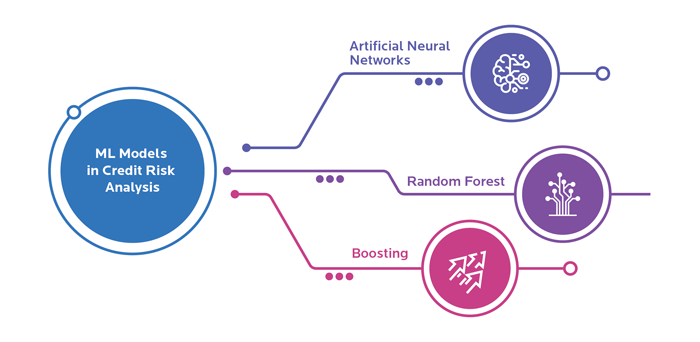
ML offers a plethora of algorithms suited for credit risk modeling, each with its strengths and limitations. Commonly used algorithms include:
- Logistic Regression: A baseline model for binary classification tasks, suitable for interpreting model coefficients.
- Random Forest: Offers robust performance with the ability to handle non-linear relationships and feature interactions.
- Gradient Boosting Machines (GBM): Iteratively improves model accuracy by combining weak learners into a strong predictor.
- Neural Networks: Complex models capable of capturing intricate patterns in high-dimensional data.
- Support Vector Machines (SVM): Effective for handling non-linear decision boundaries and complex data distributions.
- Feature Selection and Engineering:
Feature selection involves identifying the most relevant variables that contribute to credit risk prediction. Techniques like correlation analysis, mutual information, and feature importance from tree-based models aid in selecting informative features. Feature engineering enhances model performance by creating new variables or transforming existing ones to better capture underlying patterns. - Model Evaluation and Validation:
Robust evaluation and validation are essential to ensure the reliability and accuracy of credit risk models. Common metrics include:
- Area Under the Receiver Operating Characteristic Curve (AUC-ROC): Measures the model’s ability to distinguish between defaulters and non-defaulters.
- Precision, Recall, and F1-Score: Assess the model’s performance in classifying default and non-default instances.
- Calibration Curve: Examines the agreement between predicted probabilities and observed outcomes.
- Profitability Metrics: Evaluate the model’s financial impact, considering costs associated with false positives and false negatives.
- Model Interpretability and Explainability:
While ML models often outperform traditional techniques, their black-box nature raises concerns regarding interpretability. Techniques such as SHAP (SHapley Additive exPlanations) values, LIME (Local Interpretable Model-agnostic Explanations), and feature importance plots aid in interpreting model decisions and gaining insights into the factors driving credit risk. - Deployment and Monitoring:
Deploying credit risk models into production involves integrating them into existing decision-making systems. Continuous monitoring is essential to assess model performance over time and detect drifts or deviations from expected behavior. Regular model updates and recalibration ensure that the model remains accurate and relevant in dynamic financial environments.
Conclusion:
Building credit risk models using machine learning represents a paradigm shift in risk management practices within the financial industry. By leveraging advanced algorithms and techniques, institutions can enhance decision-making processes, mitigate risks, and optimize lending strategies. However, it is imperative to balance model complexity with interpretability and transparency to foster trust and regulatory compliance. With meticulous data preparation, robust model development, and diligent validation, organizations can harness the power of ML to navigate the complexities of credit risk effectively.
 Tech Consultancy Blogs
Leave a comment